

Better than “potatoes, TV, and fishing.” Minsk resident bought an old hut and converted it into something unusual
19.12.2022 41643
Stanislav Zhuravlevich, photo: Daria Buryakina, video: Yana Sionikhina
“Many people will say: well, what kind of whim is it to make an art gallery out of an old hut in a remote village far from Minsk? But our hero today thinks differently — art has no boundaries and canons. Today we went to Cheresovo to see what he did.
Oh, old acquaintances!
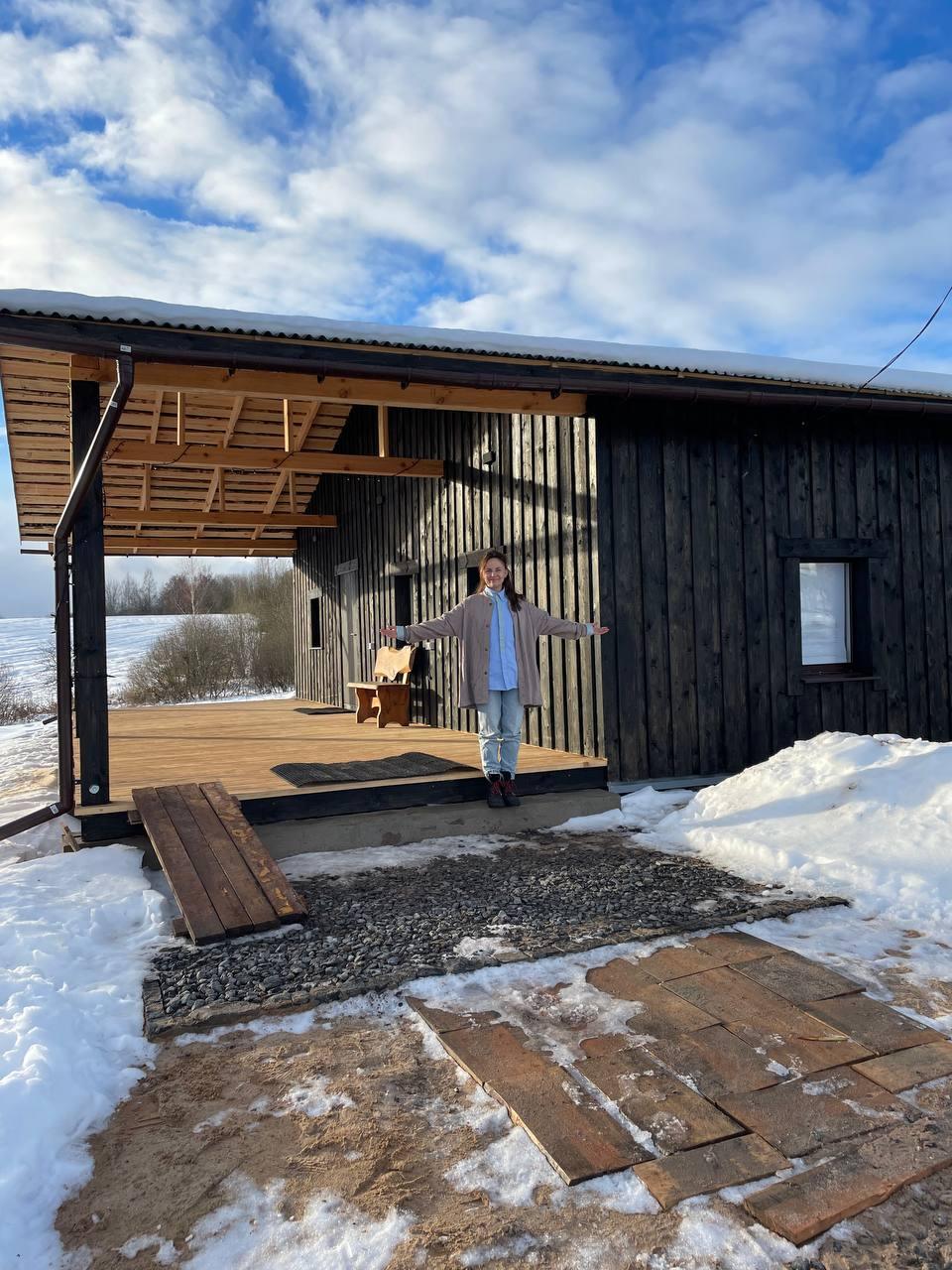
10 years ago, Artur and his wife, the artist Lora Pavlova, bought an old house in a village on the shore of the picturesque lake Cheresovo near Lepel. There was no point in repairing it — the years had not spared it, the logs were thoroughly rotten. Therefore, a new house was built in its place, and a bathhouse was built a little later. However, our reader is already familiar with this story — we wrote about construction on the shore and the philosophy of living by the water far from the city in February. But less than a year has passed and we are back in Cheresovo — we are looking at a new object. This time it was an art gallery and at the same time an artist’s studio, based on an old abandoned hut on the edge of the village.
— There was an abandoned old hut 100 meters from our house, — Arthur tells the background. — We drove by for 9 years without paying attention to her. Last year, my hunter neighbor and I went exploring the neighborhood. And from the hillock on the other side of the village, this house has a completely different view — it stands on a hill with stunning views of the lake. I shared my observations with my wife. She said at the time that she didn’t have a proper workshop where she could work. And then we thought it would be a good option. That’s why we bought this house in June. The idea of the workshop developed — there were thoughts about creating an art gallery. But is the gallery on its own, for itself, for the neighbors? Of course not. As a result, the idea finally took shape.: It will be the master’s house and the international gallery at the same time — in the old village, in the old house. And it’s great that people from different countries will come here, and paintings by different artists will be exhibited.
The second life of the old house
What was the house like? It was an ordinary wooden hut with a cold extension. No one had lived in it for a long time, the site began to overgrow with bushes and trees — in general, the usual pattern for abandoned housing.
The first thing we did was get rid of the junk that had accumulated in and around the house. And there were a lot of them — the house was built back in 1950.
Upon detailed inspection, it turned out that the roof was unsuitable for further operation — it was leaking, some structures were rotten and needed to be replaced. The extension was included in the list of priority demolitions, as a large terrace was planned in its place according to the project. As a result, a new gable roof appeared above the house, which is extended several meters forward to cover the spacious terrace.
They didn’t bother with the facade — the old log house was sheathed with an ordinary pine edged board using vent facade technology.
— In the neighborhood, the old houses are painted in traditional colors — yellow, green, blue, — says Arthur. — But since we undertook to make a gallery, we need to look especially unusual against the general background. That’s why I painted the facade black and I like the way the house looks now. There is no canon of what a gallery should look like, so we were able to do everything the way we liked. For example, when replacing old windows, installers found that they were not in the same plane as the facade, they were “blocked up”. And they wanted to install new ones already on the level. I thought it was right that the new windows should be in the same position as the old ones.
The exterior was also influenced by the panoramic window that covers almost the entire width of the wall on the lake side. To install it, I had to cut out a large piece of wall between two native window openings. Due to this, there is a lot of natural light inside. And the interior looks much more interesting.
And what’s inside?
There were plenty of jobs inside, too. First, they got rid of the old furniture, then they removed the “cultural layer” of fiberboard, newspapers and wallpaper from the walls.
— There were several framed reproductions in the house, — says Arthur. — They didn’t throw them away, they will be part of the history of a simple Belarusian hut that turned into an art gallery.
The house was divided into two parts — in the first there was a kitchen with a large Russian oven, in the second — a living room-bedroom with a microwave. In the first part, the walls were stripped to the logs of the log house. They decided to leave them in the interior — as the spirit of antiquity and part of the lived history of the house. Arthur says that it was not easy to clean them to a smooth state — the sanding took several weeks, the work was heavy and dusty. But the owners liked the result. The logs were impregnated and we see the tree in all its natural beauty — with all the flaws, traces of a barbecue, knots. The walls look as natural and atmospheric as possible, they are interesting to look at, pleasant to touch with your hands.
In the second half, the walls were plastered with clay on wooden shingles. They decided to repair the plaster and paint it white. They didn’t bother with leveling, so we see smooth white walls in the interior, but with all the irregularities.
— We left the window sills like this on purpose — they’re hidden under the plaster somewhere, but they’re showing through somewhere, – explains Arthur. – On the one hand, it looks careless, but on the other hand, why not?
Classic ceilings — beams with overlapping wide boards. They were simply cleaned and painted white. In order not to heat the street, Arthur insulated the ceiling from the attic.
An important part of the interior is a new stove—fireplace. This is the main source of heating for the gallery. Arthur did not begin to master the profession of a stove maker, he invited a specialist. Arthur does not regret the two thousand dollars he spent, the oven turned out to be excellent — compact, quickly warms up the entire gallery, and retains the accumulated heat for a long time.
A Russian oven used to stand in its place, but it took up much more space. Its functionality in the new concept turned out to be unclaimed. Besides, it was old, probably an emergency one, so it was dismantled. The old building was also turned into a pile of bricks in the courtyard. However, they soon moved back into the house, though in a different guise. The fact is that gaps appeared in the wooden floor in place of the stoves. In the end, the solution was to pave them with an old but very durable oven brick flush with the wooden floor. After impregnation with a hydrophobizer, they do not get dusty, it is easy to remove debris from them.
There are wide 8 cm thick boards on the floors. There was no point in changing them to something more modern – such floors would last forever. Therefore, they were simply repainted in a light gray color.
The owner did all the dirty and hard work himself, only sometimes he involved one or two assistants. But the mistress of the workshop herself was engaged in painting the walls and floors.
— Lora, when she saw how I painted the facade, she said that she would paint the interior herself, she didn’t trust me with this job, — Arthur laughs.
The final touch in the reformatting of the old house into a gallery is the installation of track lights and the installation of new wiring in the fire hoses. All the work took four months. However, I had to work almost daily, from morning to evening.
There is still work to be done on further landscaping around the house, but the necessary minimum is already in place — parking is provided for guests, toilets are installed.
Who needs it?
The locals were curious about the efforts of the Minsk resident — what could be done from an old hut, which, in a good way, should have been used for firewood?
— When I told them that it would be an international art gallery, I met with a frank misunderstanding, — says Arthur. — It is unclear to them how the gallery can be located in the village, well, what is it? Will the paintings just hang? Where are the potatoes?
But that doesn’t really upset our heroes. And here it is worth remembering that after the construction of the house on the shore, Arthur and Laura did a lot to diversify the lives of local people. At first, they had a whole field of lavender. The question “why not potatoes” disappeared from the agenda when the annual Lavender Lepey summer festival began to be held — there are a lot of guests, music is playing, people are chatting, having fun. And then there were no empty houses left in the village — everything was sold out. Thus, the place began to come alive, filled with meanings more complex than “potatoes, TV and fishing.”
— We always create something new: first the lavender field, now the gallery. We are trying to show people that there is something more interesting than the usual way of life. And I think that the gallery is not our last project.
By the way, the opening of the gallery/ hut of the artist “Lora Pavlova gallery Lepey” is scheduled for December 24.”
